Choosing among penetration testing firms is less about finding the loudest brand and more about matching a provider's testing model to your risk, release cycle, and compliance pressure. The strongest shortlist today includes traditional consultancies, pentest as a service platforms, crowdsourced testing networks, and compliance-focused cybersecurity services. This review breaks down ten strong options and explains how to evaluate them without getting distracted by scanner-heavy reports or vague "elite hacker" language.
What should you look for in a penetration testing firm?
A good penetration testing firm should prove exploitable risk, explain business impact, help your team remediate, and deliver evidence your auditors can actually use. That means the best penetration testing partner is rarely the cheapest vulnerability scan; it is the provider that combines skilled manual testing, clear scoping, actionable reporting, retesting, and the right compliance context for your environment.
Before comparing vendors, define what you need tested. A SaaS company preparing for SOC 2 may need web app, API, cloud, and developer-friendly retesting. A retailer may need a pci pentest, payment-page script review, and documentation that supports an assessor's expectations. A federal contractor may need FedRAMP alignment and a provider comfortable with government systems.
Use this checklist during evaluation:
- Testing depth: Ask how much is manual, how findings are validated, and whether testers chain vulnerabilities to show real impact.
- Scope fit: Confirm coverage for web apps, APIs, mobile, cloud, internal networks, external attack surface, wireless, AI systems, or hardware as needed.
- Compliance readiness: Look for support around PCI DSS, SOC 2, HIPAA, ISO/IEC 27001, FedRAMP, or industry-specific obligations.
- Remediation support: Prioritize clear reproduction steps, severity rationale, developer guidance, and retesting.
- Delivery model: Decide whether you need a one-time consulting engagement, continuous PTaaS, crowdsourced capacity, or red team operations.
- Signal quality: Ask how the provider controls false positives and distinguishes a vulnerability assessment from a true penetration test.
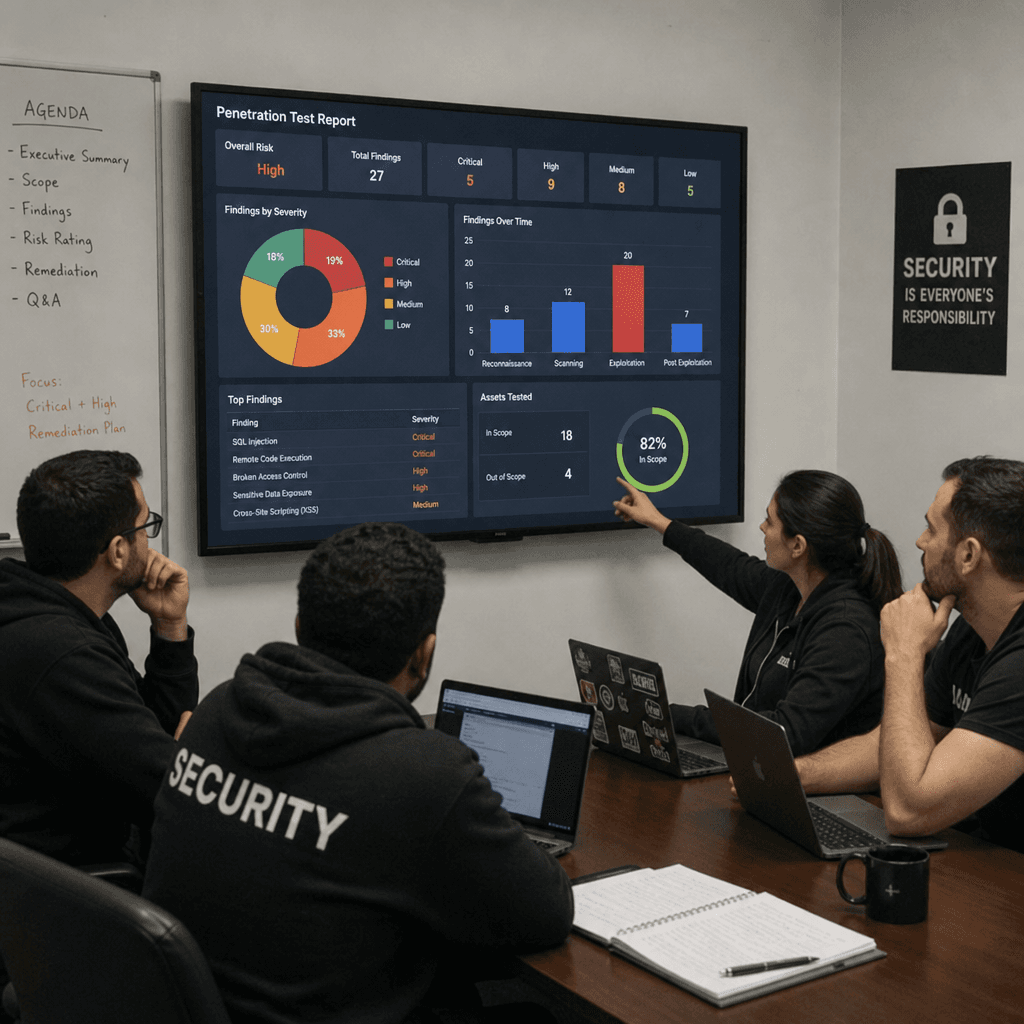
The top 10 penetration testing companies to consider
This list is not a universal ranking for every buyer. It is a practical review of top security companies and specialist providers for different maturity levels, from agile startups to regulated enterprises.
1. Synack
Synack is a strong fit for enterprises and government teams that want continuous testing with vetted researchers and platform control. The company's FedRAMP Marketplace listing shows its On-Demand Security Testing Platform at a Moderate authorization level, and Synack describes a model that combines vetted human researchers with agentic AI support for federal continuous pentesting. That makes it especially relevant for organizations that need external penetration testing services with strong governance and audit sensitivity. (fedramp.gov)
Synack may be more than a small startup needs, but it belongs near the top for mature programs with recurring testing requirements, large attack surfaces, and public-sector expectations.
2. NetSPI
NetSPI is best for large organizations that want deep manual testing plus a mature PTaaS platform. NetSPI states that its PTaaS model provides access to more than 350 in-house pentesters and covers areas including applications, cloud, hardware, networks, mainframes, and AI or ML systems. Its positioning is well suited to companies that need broad it security testing across many business units rather than a single web app report. (netspi.com)
Choose NetSPI when you want a consultative partner, recurring program management, and the ability to move beyond checkbox testing into a more continuous security workflow.
3. Bishop Fox
Bishop Fox is a premium offensive security firm for organizations that need red teaming, application penetration testing, attack surface management, and adversary-driven exercises. In 2026, the company announced AI-augmented application penetration testing tied to its Cosmos AI capabilities, and its site positions Bishop Fox around continuous penetration testing, red teaming, cloud, hardware, and application assessments. (bishopfox.com)
It is a compelling option for security-mature enterprises that want realistic attacker simulation, not just compliance evidence. Expect to evaluate scope carefully, because advanced red team work can expand quickly if goals are not defined.
4. Cobalt
Cobalt is a recognizable pentest as a service provider for agile engineering teams that want faster launch cycles, platform-based collaboration, and human validation. Cobalt describes its credits as units consumed when testing needs arise, with workflow coverage that includes automated detection, expert human validation, orchestration, and findings delivery. The company also positions its PTaaS around continuous and risk-triggered testing rather than purely calendar-based assessments. (cobalt.io)
Cobalt can be a good fit for mid-market SaaS companies with frequent releases and multiple application scopes. Buyers should ask about tester continuity, retest terms, and how complex business-logic testing is handled.
5. HackerOne
HackerOne is best known for crowdsourced security, but H1 Pentest brings that talent model into structured pentesting. HackerOne describes H1 Pentest as PTaaS with a vetted pool of pentesters, support for web apps, APIs, networks, and mobile apps, plus real-time findings and AI-enhanced reporting. (hackerone.com)
This model works well for teams that value broad researcher access, fast feedback, and a platform experience. If your environment requires highly specialized continuity or deep internal architecture knowledge, ask how HackerOne assigns testers and maintains context across engagements.
6. Bugcrowd
Bugcrowd is a strong option for companies that want crowdsourced testing capacity with structured PTaaS delivery. Bugcrowd says its Pen Testing as a Service can launch standard or customized testing quickly, use curated pentester teams, provide real-time visibility, and support compliance and remediation workflows. It lists many test types, including network, web application, mobile, cloud, API, AI, IoT, social engineering, and attack surface testing. (bugcrowd.com)
Bugcrowd is often attractive for teams that want flexibility and scale. It may be especially useful when paired with a vulnerability disclosure or bug bounty program, though a bounty should not automatically replace a scoped pentest.
7. Coalfire
Coalfire is a natural shortlist candidate for regulated organizations, especially those focused on FedRAMP and PCI. Coalfire Federal lists FedRAMP support that includes performance of a FedRAMP penetration test, and the FedRAMP Marketplace lists Coalfire Systems as an assessor. (coalfirefederal.com)
If your priority is audit defensibility, Coalfire's compliance orientation may be more important than having the flashiest PTaaS dashboard. It is particularly relevant when the cost of pci compliance includes advisory work, control validation, evidence collection, and penetration testing rather than testing alone.
8. BreachLock
BreachLock is positioned around PTaaS, attack surface management, autonomous testing, and certified penetration testing in one workflow. The company states that teams can scope, schedule, track, remediate, and validate fixes through its platform, with unlimited retesting and audit-ready reporting mapped to SOC 2, PCI DSS, ISO 27001, HIPAA, and other frameworks. (breachlock.com)
This can be useful for teams that want a modern platform but still need human-led services. As with any AI-powered provider, ask where automation ends, where manual validation begins, and how proof of exploit is documented.
9. Rapid7
Rapid7 is a good fit for organizations that want penetration testing connected to a broader security operations and vulnerability management ecosystem. Its penetration testing services include web application testing and continuous red team operations through Vector Command, and Rapid7 also maintains Metasploit, a widely used penetration testing framework. (rapid7.com)
Rapid7 may appeal to teams already using its broader platform, or buyers who want cybersecurity services that connect assessment findings to remediation and detection workflows.
10. Software Secured
Software Secured is a focused choice for software companies that need manual, exploit-driven application and API testing with audit-ready evidence. The company positions its services around manual pentesting, built-in retesting, and compliance needs including SOC 2, HIPAA, PCI DSS, and ISO 27001. (softwaresecured.com)
For startups and growing SaaS teams, this kind of specialist can be easier to work with than a large consultancy if the main need is clear application security evidence for customers, auditors, or enterprise sales.
PTaaS, crowdsourced testing, or traditional consulting?
PTaaS is usually best when you need repeated testing, dashboard visibility, retesting workflows, and faster coordination with engineering teams. Traditional consulting is often better for complex environments, deep architecture reviews, internal network compromise paths, and red team objectives. Crowdsourced models can add speed and breadth, but buyers should confirm tester vetting, methodology, continuity, and reporting quality.
Think of vulnerability assessment companies as useful for finding and prioritizing possible weaknesses, especially across large asset inventories. A penetration test goes further by validating exploitability and showing what an attacker could actually do. The most effective programs use both: automated discovery for coverage and manual testing for proof, context, and business impact.
How much should you expect to spend?
Pricing varies by scope, complexity, environment type, compliance requirements, and retesting expectations. A small web app test may be a modest project, while enterprise programs with multiple applications, cloud environments, internal networks, and red team scenarios can become a significant annual investment. For PCI, the cost of pci compliance may also include QSA advisory, ASV scanning, remediation labor, payment-page controls, policy work, and evidence management, not just the pci pentest itself.
Ask vendors to separate the quote into practical pieces:
- Scoping and kickoff: What assets, roles, credentials, and test windows are included?
- Testing effort: How many tester-days are manual versus automated?
- Reporting: Will the report map to PCI DSS, SOC 2, HIPAA, FedRAMP, or ISO/IEC 27001 needs?
- Retesting: Is validation included, limited, or billed separately?
- Ongoing access: Does the price include a platform, dashboard, integrations, or continuous monitoring?
PCI 6.4.3 and 11.6.1 deserve special attention
Teams searching for the best companies specializing in 6.4.3 and 11.6.1 cybersecurity are usually worried about payment-page scripts, e-skimming, and audit readiness. PCI SSC explains that Requirement 6.4.3 is intended to prevent unauthorized code from executing in the consumer's browser as the payment page is rendered, and PCI SSC has published guidance focused on payment page security and e-skimming for Requirements 6.4.3 and 11.6.1. (pcisecuritystandards.org)
For this use case, prioritize providers with PCI experience, web application testing depth, and practical knowledge of third-party scripts, content security controls, change detection, and payment-page monitoring. Coalfire, BreachLock, Software Secured, NetSPI, and Synack may all be worth evaluating depending on whether you need QSA-led compliance support, PTaaS execution, software-focused testing, or enterprise-grade governance.
The best choice depends on your risk profile
If you are comparing old searches for the top 10 penetration testing companies in 2026 with today's market, the biggest change is the rise of AI-assisted testing and continuous PTaaS. Still, the fundamentals have not changed: the best companies validate findings, explain exploit paths, reduce false positives, and help your team fix what matters.
For enterprise and government needs, start with Synack, NetSPI, Bishop Fox, Coalfire, and Rapid7. For agile SaaS and mid-market teams, compare Cobalt, HackerOne, Bugcrowd, BreachLock, and Software Secured. The right provider should make your security program clearer, not noisier, and turn penetration testing from an annual scramble into a repeatable way to reduce real risk.