IAST and DAST are two application security testing methods that look at software from different angles. IAST watches an application from the inside while it runs, while DAST tests it from the outside like an attacker would. Understanding IAST vs DAST helps teams choose the right mix of tools, reduce false positives, and build stronger API security across development, testing, and production workflows.
What is the difference between IAST and DAST?
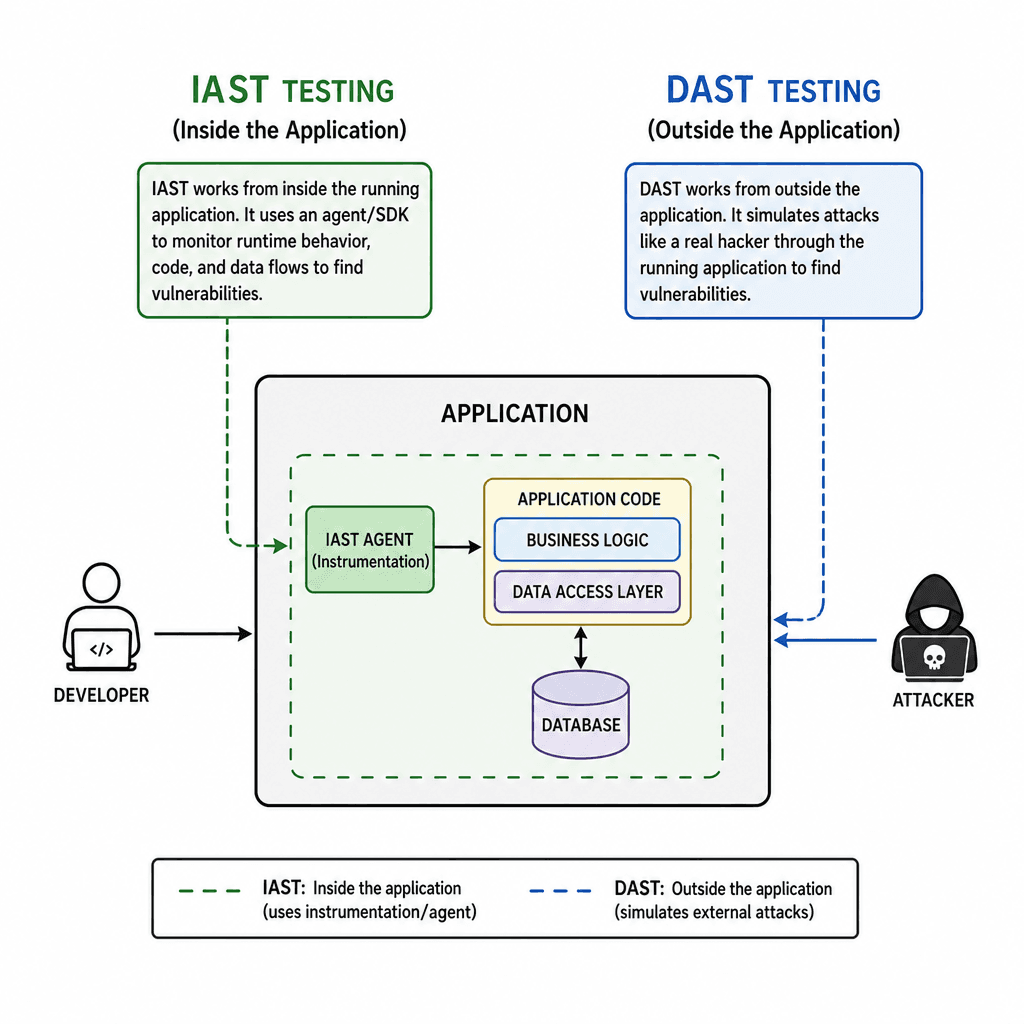
The core difference is perspective: IAST has internal visibility into the running application, while DAST interacts with the application externally without seeing the code, framework, or runtime behavior. IAST is often used during development and QA because it can connect a vulnerability to the code path, data flow, or function involved. DAST is commonly used against deployed applications, staging environments, or external-facing APIs to see what an attacker can actually reach.
IAST stands for Interactive Application Security Testing. It usually relies on sensors or agents embedded in the application runtime. As automated tests, QA scripts, or manual users exercise the app, IAST observes how inputs move through the system and flags risky behavior with more context than a purely external scanner can provide.
DAST stands for Dynamic Application Security Testing. It sends requests to a running web app or API, looking for issues such as injection flaws, authentication weaknesses, misconfigurations, exposed endpoints, and unsafe error responses. Since DAST does not require source code access, it is useful for black-box testing, third-party applications, and production-like validation.
IAST gives developers context earlier
IAST is most valuable when teams want fast, actionable feedback inside the software development lifecycle. Because it runs with the application, it can often show where a vulnerability occurred, what input triggered it, and how the application processed that input. That context helps developers understand whether a finding is real and where to fix it.
This matters because security testing often fails when results arrive too late or lack enough detail. A vague alert that says "possible injection" can create a long triage cycle. A clearer finding that points to a specific route, parameter, library behavior, or code path gives engineering teams a better starting point.
IAST can also fit naturally into CI/CD when test coverage is strong. If automated functional tests exercise login, checkout, account settings, or API workflows, IAST can observe those flows during the pipeline. The tradeoff is setup: teams usually need runtime access, agent configuration, and enough test activity to expose meaningful behavior.
DAST shows what attackers can reach
DAST is valuable because it tests the application from the outside. It does not care how the app is written, what language it uses, or which team owns the code. If an endpoint is reachable and responds to requests, DAST can probe it for weaknesses.
That makes DAST especially useful for internet-facing applications and APIs. It can validate whether authentication is enforced, whether inputs are handled safely, whether sensitive errors leak through responses, and whether common attack patterns succeed. It also helps teams test systems where source code is unavailable, such as vendor portals, legacy applications, or acquired software.
DAST does have limits. It may not know which internal function caused a vulnerability, and it can miss issues hidden behind complex workflows or untested business logic. Scans may also require careful tuning so they do not overload fragile environments, trigger unwanted transactions, or generate noisy results.
How do IAST and DAST work together for API security?
IAST and DAST complement each other because APIs have both internal behavior and external attack surfaces. IAST can reveal how an API request moves through application logic, while DAST validates what an unauthenticated or authenticated attacker can do from the outside. Used together, they provide stronger coverage than either method alone.
For API security testing, DAST is often the first visible layer. It can scan REST endpoints, test common payloads, inspect status codes, and check whether access controls behave as expected. It is helpful for confirming that public routes, partner APIs, and staging environments do not expose obvious weaknesses.
IAST adds deeper insight. If a REST API accepts user input, calls internal services, and writes to a database, IAST may show whether that input is sanitized, how authorization checks are handled, and where risky data flows occur. This is particularly useful when teams are trying to fix root causes rather than simply patch symptoms.
A practical API testing program often combines:
- SAST to inspect code before the application runs.
- IAST to observe runtime behavior during functional testing.
- DAST to test exposed endpoints from an attacker's viewpoint.
- Manual penetration testing to find complex business logic, authorization, and chaining issues.
- Runtime monitoring or protection to detect suspicious behavior after release.
A practical API security checklist for teams
An effective api security checklist should be short enough to use regularly but detailed enough to catch meaningful risk. The goal is not to create paperwork; it is to make sure every release answers the same critical security questions.
Use this checklist as a starting point for REST APIs:
- Inventory every endpoint. Include public, internal, deprecated, partner, and admin routes. Unknown endpoints are difficult to test and easy to forget.
- Verify authentication. Confirm that protected endpoints reject unauthenticated requests and that tokens, sessions, and keys are handled safely.
- Test authorization deeply. Check whether users can access another user's records, escalate roles, or call admin-only functions.
- Validate all inputs. Test query parameters, headers, request bodies, path variables, file uploads, and nested JSON fields.
- Control output exposure. Make sure responses do not reveal secrets, stack traces, internal IDs, or excessive personal data.
- Handle errors safely. APIs should fail clearly for clients but quietly about internal implementation details.
- Apply rate limits and abuse controls. Protect login, search, export, password reset, and high-cost endpoints.
- Check dependencies and integrations. APIs often depend on external services, SDKs, and libraries that can expand risk.
- Log security-relevant events. Capture authentication failures, permission denials, suspicious request patterns, and sensitive changes.
- Retest after fixes. A closed ticket is not the same as a verified remediation.
These points align closely with rest api security best practices because they focus on identity, input, access control, error handling, and operational resilience. IAST can help confirm what happens inside the API during these checks, while DAST can validate what is exposed externally.
Choosing the right testing method
The right choice depends on where your application is in the lifecycle, what access you have, and what kind of risk you need to reduce. In most mature programs, the answer is not IAST or DAST. It is a layered approach that uses each method where it performs best.
Choose IAST when:
- Your team controls the application code and runtime.
- Developers need detailed remediation guidance.
- You have automated tests or QA activity that exercises important workflows.
- You want security feedback earlier in CI/CD.
- Reducing false positives is a major priority.
Choose DAST when:
- You need to test a deployed app, staging site, or public API.
- You do not have source code or runtime access.
- You want a black-box attacker perspective.
- You need language-independent testing across multiple applications.
- You want to validate exposed routes before or after release.
Use both when the application handles sensitive data, supports critical business workflows, or exposes APIs to customers, partners, or mobile apps. APIs are often the connective tissue of modern products, so a single missed authorization flaw can have wide impact.
Where penetration testing still fits
Automated tools are powerful, but they do not replace human judgment. Penetration testers can chain lower-risk findings, spot unusual business logic flaws, test role boundaries creatively, and challenge assumptions that scanners may not understand. This is especially important for APIs where the most serious issue may not be a classic injection bug, but an action the user should never have been allowed to perform.
When evaluating the best penetration testing company for your needs, look beyond a generic vendor list. The right partner should understand APIs, modern CI/CD workflows, cloud environments, authentication models, and the business context of your application. If API risk is your main concern, the best companies for api security testing are usually the ones that can combine automated coverage with skilled manual testing and clear remediation support.
Ask potential providers how they handle:
- API documentation, collections, schemas, and authentication setup.
- Testing for broken object-level authorization and role abuse.
- Retesting after remediation.
- Communication with developers during the engagement.
- Reporting that separates confirmed risk from theoretical noise.
- Coordination with your release schedule and production safeguards.
Understanding pricing without chasing the cheapest option
Penetration testing pricing varies because scope varies. A small API with a handful of endpoints is not the same engagement as a large platform with multiple roles, integrations, admin functions, and complex data flows. Frequency also matters: a one-time annual test has different planning needs than continuous or release-based testing.
When comparing penetration testing services pricing, pay attention to what is included. Some services focus on automated scanning and basic reporting, while others include manual validation, exploit chaining, remediation calls, and retesting. A lower price may be reasonable for a narrow validation exercise, but it may not provide enough depth for a critical API that processes sensitive information.
Useful budgeting questions include:
- How many applications, APIs, roles, and environments are in scope?
- Are testers validating business logic or only common technical vulnerabilities?
- Is authenticated testing included?
- Will the provider retest fixes?
- Are findings explained in developer-friendly language?
- Does the engagement include a kickoff, status updates, and a readout?
The goal is not to buy the biggest report. The goal is to reduce real risk in a way your engineering team can act on.
Building IAST and DAST into DevSecOps
Security testing works best when it becomes part of normal delivery rather than a separate event at the end. IAST can run during automated test execution, giving developers feedback before a release candidate is finalized. DAST can scan staging or production-like environments to confirm that deployed behavior matches security expectations.
A practical workflow might look like this:
- Developers run secure coding checks and unit tests before merging.
- CI/CD triggers functional tests with IAST observing runtime behavior.
- A staging deployment is scanned with DAST against documented API endpoints.
- High-risk findings are triaged by security and engineering together.
- Critical fixes are retested before release.
- Periodic penetration testing validates complex workflows and attacker chains.
This approach keeps security closer to the work. Developers get earlier feedback, security teams get better evidence, and product teams avoid discovering major issues only after launch.
The real takeaway
IAST and DAST solve different parts of the same problem. IAST helps teams understand what is happening inside a running application, while DAST shows what an attacker can reach from the outside. For API-heavy systems, using both methods alongside SAST, manual penetration testing, and a practical API security checklist creates stronger protection than relying on one tool alone.
If you are deciding where to start, begin with your biggest exposure. For a public REST API, DAST and a focused penetration test can quickly reveal external risk. For a fast-moving development team, IAST can improve feedback and shorten remediation cycles. The strongest programs do both, then keep refining coverage as the application changes.